AI takes over more tasks, but people still have to review results, answer requests and supervise it. Anthropic's internal data and employee interviews show how rising output is stretching human attention and changing both daily work and hiring.
At Anthropic, Claude writes code, fixes bugs and schedules meetings. It also helps salespeople draft emails and lawyers review public-facing copy. Employees use more than a chat window: they work with AI agents, programs that can use tools and carry out tasks over multiple steps.
What happens to people's jobs when these tools become part of everyday work? A report published by the Anthropic Institute on 2026-10-16 examines the company's own employment records, AI usage logs, output measures, surveys, Slack messages, calendars and hiring assessments. It also draws on 17 employee interviews.
The findings go beyond faster execution. Agents produce more results and requests, but people have limited time to deal with them. Employees increasingly organize and supervise agents rather than do each task themselves. At the same time, junior employees make up a smaller share of technical hires, and hiring managers place more weight on autonomy and judgment.
The authors see Anthropic as a possible early example of changes that could spread elsewhere. It is still one company studying itself, however, and one that both uses AI extensively and sells the models. Its experience is not a picture of every workplace.
Some agents at Anthropic work back and forth with an employee. Others run unattended, sometimes in large groups that add tests, maintain infrastructure code or translate large codebases. In March 2026, the combined working hours of these interactive and autonomous agents first exceeded human work hours.
Even when the researchers count only employee-directed interactive sessions, the total reaches 6× human work hours by August. That includes subagents, which an agent starts to handle parts of a task. The chart shows 19× for research organizations. These ratios compare accumulated working time, not the number of employees an agent could replace.
Human hours are estimated at 40 hours per employee per week. Agent hours include model processing and active tool use, but exclude waits longer than 30 minutes. The March comparison includes both autonomous and interactive agents; the August ratio excludes the unattended fleets.
Output per employee also rose across several jobs. Taking December 2025 as 100, the chart shows code commits per engineer reaching 5.1× their earlier level. A commit records a set of code changes; the report's text summarizes the increase as 5x the pace six months earlier. Queries per data scientist and contracts per legal employee both reach 3.1×, deals per salesperson 1.7×, and hires per recruiter and invoices per accounts-payable processor both reach 1.4×.
Those increases cannot all be credited to AI. Anthropic's business was growing rapidly, and selling a stronger model can itself make deals easier to close. To separate these changes as far as possible, the researchers track the same employees before and after they start using agents, and compare them with employees who have not adopted the tools in the same month.
The engineering comparison includes 192 adopters and 74 people who do not adopt during the study. The first month with at least five agent sessions counts as the start of adoption. Engineers add substantially more code in the following months. A separate comparison finds that sales representatives close deals with more clients after adopting agents.
The authors point out that employees choose when to start using these tools. Someone preparing a large project may adopt them in advance; a salesperson with more opportunities may have more reason to automate routine work. Engineers adopting fully autonomous agents were already on a steep upward trajectory beforehand. The comparisons therefore cannot completely separate tool use from other reasons for rising output.
Does more code also mean more mistakes? The researchers compare agent-written code with code written directly by the same employee, in the same month and code directory. They find no difference in how often lines are later removed or reverted, meaning the change is undone. These measures capture only part of code quality, and the authors note that AI errors may be harder to spot.
The interviews show what this looks like day to day. One account executive said Claude took over around 20% of their previous tasks, including drafting emails and integrating with customer-management software. Another used the time saved for face-to-face conversations and could speak to 30% more customers. Their habit was to look for a way to automate a task whenever they found themselves doing it a second time.
A lawyer used Claude to scan for risks, sort legal questions and take a first pass through public-facing copy. A recruiter used it to find candidates, track applications and carry out analysis, leaving more time to update interview questions and meet applicants.
New models also lead employees to attempt harder tasks. The researchers use Claude to score coding sessions with identifying information removed. They set a threshold at the hardest 10% of tasks handled with the old model. After a new model is released, tasks above that threshold rise from 10% to 13% of all tasks, an increase of around 30%, and remain elevated in the following weeks. The easy end changes little.
Employees have high expectations for future capabilities too. As of August, they expected AI to be able to do 75% of their work by 2030, compared with 28% for other Americans. In a separate survey question, agreement that work processes made employees as productive as possible rose from 44% in late 2024 to 58% in November 2025. It reached 75% in April 2026, but that question dropped the words “as possible,” so the results are not directly comparable.
One engineer compared managing agents to babysitting: a child who cannot open a juice box can sound just as urgent as one with a bleeding finger. The difficulty is deciding which request needs attention when all of them seem to demand it:
"They're like, I need my juice box opened and it's an emergency that my juice box is opened. And that is voiced with the same level of concern as the one who has sliced their finger and is bleeding. [...] When you are babysitting, every child brings to you concerns with an equal demand for your attention and the various [Claudes] also do that."One Anthropic engineer
In the April 2026 survey, 27% of employees described productivity gains when asked how AI had changed their daily work. Another 20% described a shift from doing tasks themselves to managing Claudes.
The session logs show how much waiting is involved. In back-and-forth exchanges between an employee and Claude, around 80% of session time is spent waiting for human input. The researchers calculate that share by subtracting the agent's active working time from the session's total elapsed time.
This is a measure of interactive sessions, not a claim that unattended agents spend most of their time idle.
There is also the question of what happens after an answer arrives. How long would it take an employee to read every word Claude produces? The researchers estimate this at a reading speed of 250 words per minute. They convert tokens, the units used to measure model text, at 0.75 words per token.
For engineering and research, the chart shows 424 hours to read one person's weekly output. That is an estimate of the time needed to read everything, not the time anyone actually spent reading.
The non-technical figures are substantial too: 43 hours for finance and accounting, 35 for sales and go-to-market, 27 for other non-engineering roles, 26 for legal, policy and trust, and 12 hours for marketing and communications. The report describes the burden on non-technical groups as over half a work week, but the departments differ. Marketing is below that level.
Organizing this output becomes another part of the job.
An army of Claudes, with every one asking for my attention.One Anthropic engineer
Some employees use agents to manage other agents. One engineer set up an agent chief of staff to sort incoming requests. Another wrote a performance review for their Claude team, discussing which ways of communicating were working. Recruiters built dashboards where agents could flag problems and start actions.
Employees also write reusable instructions explaining how agents should work. These grew from a few hundred in July 2025 to 8,500 a year later. A lawyer described a shift from reviewing individual legal questions toward “SEO for legal advice”: writing legal frameworks that clients' agents can discover. The comparison with search optimization is about making advice findable by agents.
The report calls this preparation and supervision “meta-work.” It includes planning tasks for several agents, having one agent review another's results, and building dashboards to track their progress. Its share of the average employee's interactive sessions rose from 10% in fall 2025 to 22% in spring 2026. Those are shares of sessions, not of total working hours.
The researchers estimate these shares by automatically classifying 2,000 one-line chat summaries. The chart shows infrastructure at 29%, security and trust at 27%, developer tooling and product engineering each at 26%, safety research at 25%, other technical roles at 24%, model research at 22%, data science at 19%, sales at 15%, and finance, legal and marketing combined at 12%.
Managing agents has not removed the need for people to coordinate with one another. Employees describe bug investigations that reveal organizational problems, system issues or older technical problems that people must discuss and resolve. Calendar records show the median employee spending 20% more time in meetings than a year earlier. Company growth and a shift toward meeting-heavy roles explain part of that, but technical employees without management roles also spent 16% more time in meetings.
As code writing, bug finding, progress logging and email drafting become more automated, one non-technical employee described the change as “that 20% that was strategic becomes 90% of the job”. That is an interviewee's account of their own work, not a company-wide measure. Sales calls, interviews and discussions across teams still depend on human interaction.
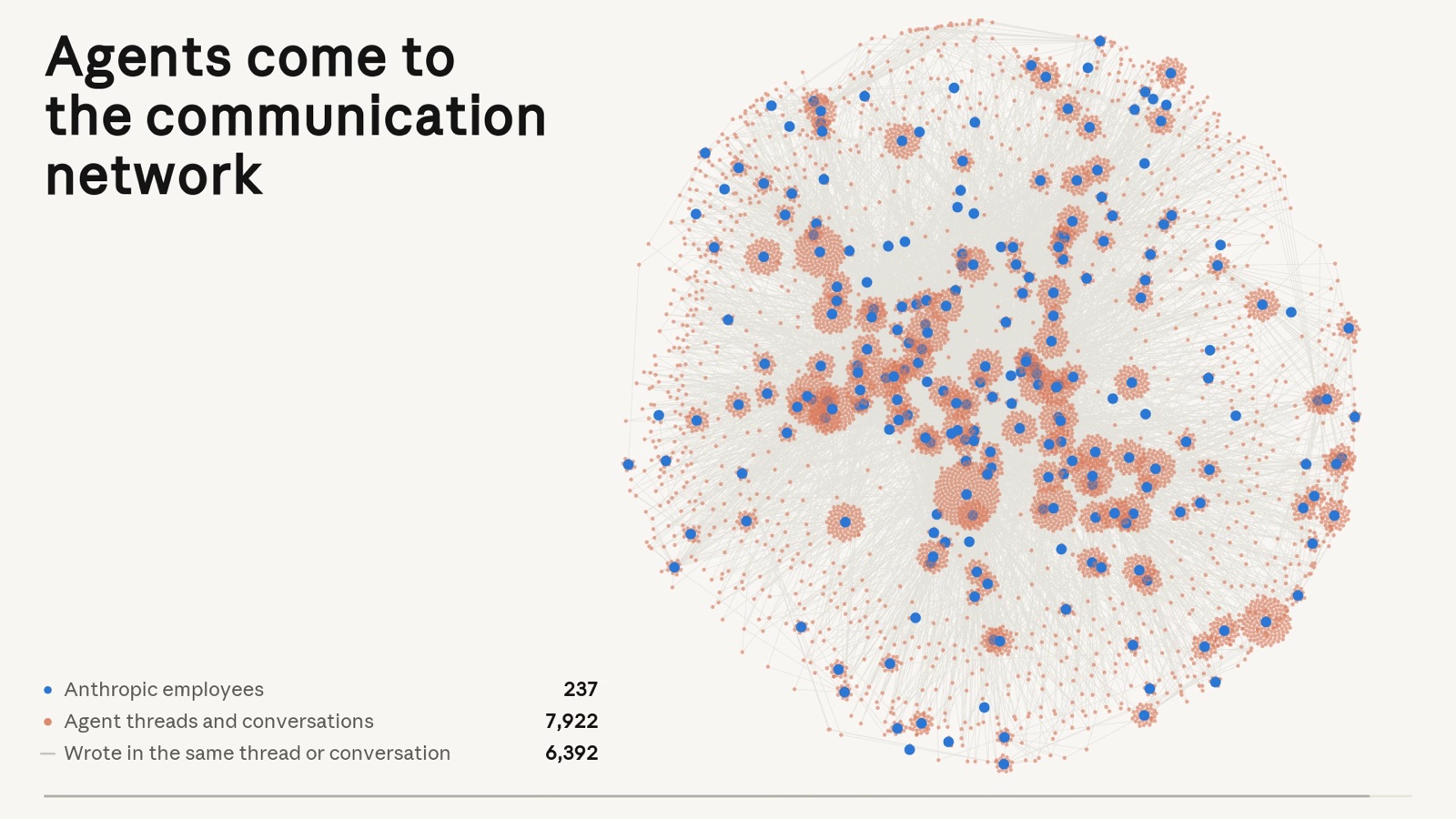
Slack, the company's messaging platform, shows a similar pattern. Agents eventually appeared in nearly half of active public channels. A chart of one large department identifies 237 employees and 7,922 agent threads and conversations. Yet agents mostly appeared in channels dedicated to human–Claude exchanges. Existing human discussions kept the same number of human responses, with agent replies added alongside them. Agents looked more like a team of assistants around one employee than a replacement for communication between employees.
Agents do not automatically know what people have agreed in person. If a meeting ends with a decision but no notes or written update, they lack information needed to adjust their goals and assumptions. Old documents can mislead them too. One employee's name remained on a months-old document about Claude merchandise, so agents kept bringing them requests for t-shirts and mugs long after their responsibilities had changed.
The report argues that work and decisions need records that agents can read. Unrecorded meetings and private messages leave gaps in what agents know. One researcher described this openness as a major change from how most organizations work: leaders also have to give feedback in the open and explain it there.
Agents do not automatically know what people have agreed in person.Section summary · Meeting decisions need records that agents can read
Anthropic had tripled its workforce over the preceding year. Yet it employed fewer people per dollar of revenue than an earlier generation of large technology companies. When Anthropic was about five years old, its revenue per employee was 2–4× that of Meta and Google at the same stage. The comparison uses Anthropic's twelve months to April 2026 and Google and Meta filings for 2003 and 2009 respectively, with all revenue adjusted to 2025 dollars.
In January 2026, core technical teams began discussing whether they needed as many junior employees. Teams relying heavily on Claude found they could hand over more code writing and bug finding to it.
By April, engineering and research teams were placing less emphasis on junior hiring. Most managers surveyed said AI had changed the skills they sought; around a third of machine-learning managers and a fifth of software-engineering managers said they were hiring less because of AI.
Two sets of figures describe different groups. Since early 2025, junior employees' share of the existing technical workforce fell from 21% to 14%. Their share of new technical hires fell from 27% to 9%. Job postings for junior roles declined particularly sharply after December 2025.
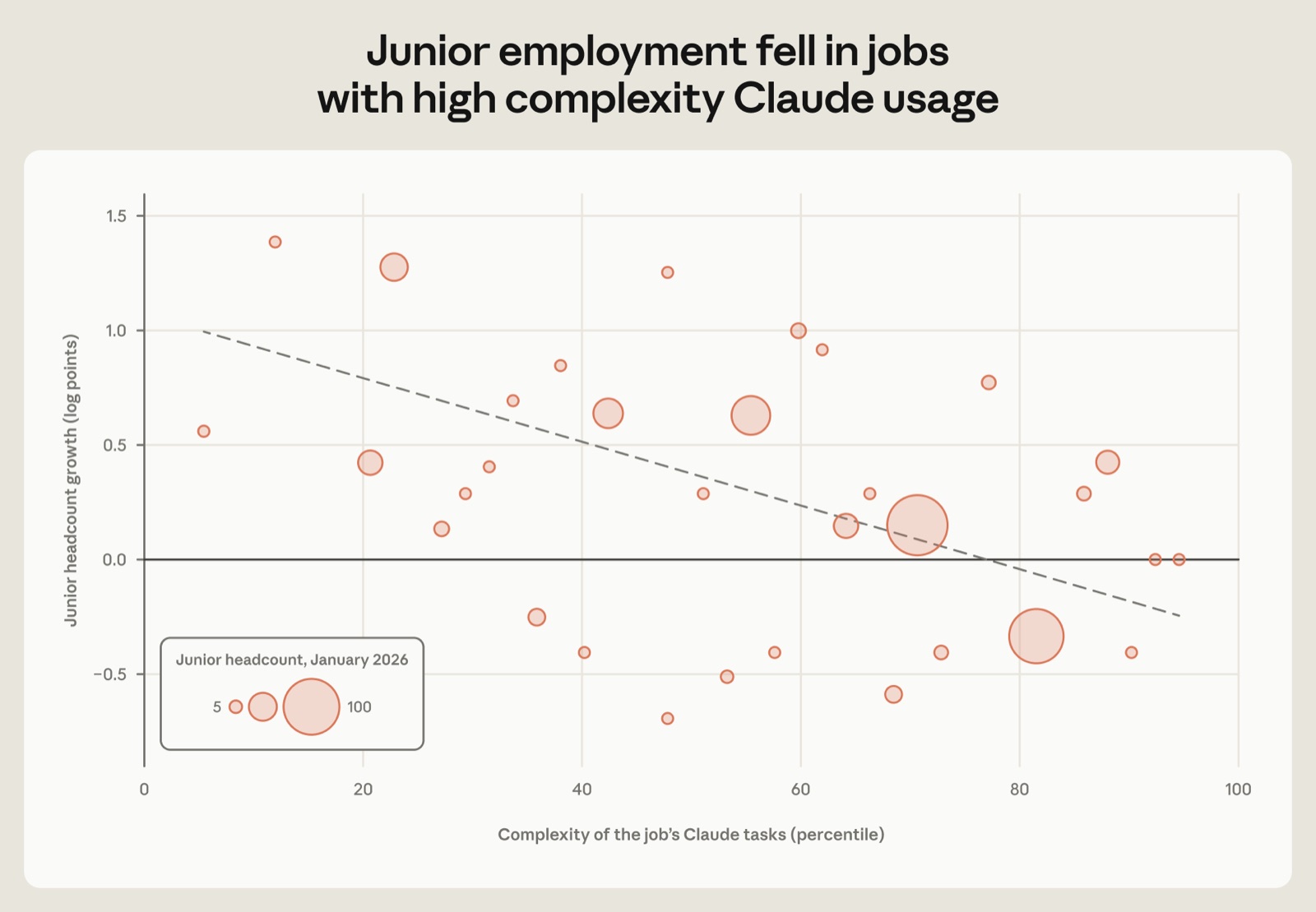
Junior headcount also grew more slowly in jobs using Claude for the most complex tasks. This shows two patterns occurring together; the chart alone does not establish that one caused the other.

Technical departments' share of all employees fell from 61% to 56%, although technical hiring continued to grow in absolute numbers. Sales, finance and recruiting simply grew faster. The report attributes part of this to business expansion and suggests that coding tools may also allow non-technical employees to build software themselves. One salesperson built a custom dashboard and workflow in three to four hours, despite previously finding the interface and tool connections beyond their skills.
The researchers also followed non-technical employees who had made no code commits at the start, excluding new hires. Their coding-focused agent sessions rose from 2 per month in August 2025 to 90 in May 2026.
Supervisory and coordinating roles in technical teams increasingly involved writing code as well. The share of technical employees with no commits in the previous 30 days fell by almost half over the year to April 2026, while managers' commits doubled. The ratio of engineers to product managers was approximately 17 to 1, higher than in 2025.
Administrative hiring did not accelerate with company growth, and clerical work grew slowly. One executive assistant built an agent to schedule meetings and sort emails, then focused on higher-level coordination. In their view, Claude was already taking over work associated with entry-level administrative roles.
People were moving into new roles too. Employees with at least a year at Anthropic were 50% more likely to change departments each month in 2026 than in 2025. One product-design team had written content such as the greetings on Claude.ai. In spring 2026, it organized background information into a context graph that guided agents in writing product copy. Once agents could take on that work, the team moved into writing prompts and evaluations of model behavior. The writers were still working with language, but now to guide Claude rather than influence users.
Hiring assessments changed alongside the work. The researchers automatically classified interview score cards for thousands of hires since 2024. In 2024, around 5% of technical assessments and 7% of non-technical assessments mentioned creative use of AI tools. By 2026, those rates had tripled and quadrupled respectively.
For technical candidates, comments about autonomy and judgment increased the most, while domain expertise made up a smaller share of assessments. One manager explained that models would remain uneven in their abilities, so they wanted people who could work across domains. For non-technical candidates, more attention went to commitment to customers and the company's mission, and less to execution skills.
The report closes with three approaches at Anthropic: employee stock ownership so that workers share in the company's success; an early warning system that tracks how AI is changing demand and output in different roles; and a preference for moving affected employees into jobs that fit their skills and may face less immediate disruption. The authors argue that relying on external hiring for every new task becomes harder as AI changes work faster.
They also acknowledge that these approaches will not suit every company. Stock ownership is easier to champion when the company's value is rising rapidly. A commitment to find new roles for existing employees can be costly and may make employers more cautious about hiring newcomers. On the other hand, prioritizing internal moves encourages a company to find new tasks and products, rather than focus only on replacing people to cut costs.
These measures cannot prevent AI from disrupting jobs, and they do not directly address slower junior hiring. Protecting existing employees does not help people who were never hired. The report therefore also calls for government policy on retraining and income support alongside action by employers.
An Anthropic Institute technical report, published 2026-10-16, by Nathan Wilmers, Regina Catipon, Maxim Massenkoff and Peter McCrory. It draws on internal company records and 17 employee interviews.
This article summarizes that single report. Business growth and agent adoption happened at the same time, so not all output growth can be credited to AI. The code-quality comparison covers only the measures described in the report. Other differences in what is counted are explained alongside the relevant findings.
Values identified as chart readings come from the original figures. Figures 1, 2, 3, 3b, 4, 5 and 7 are redrawn, with approximate readings labelled; Figures 6 and 8 use the originals.